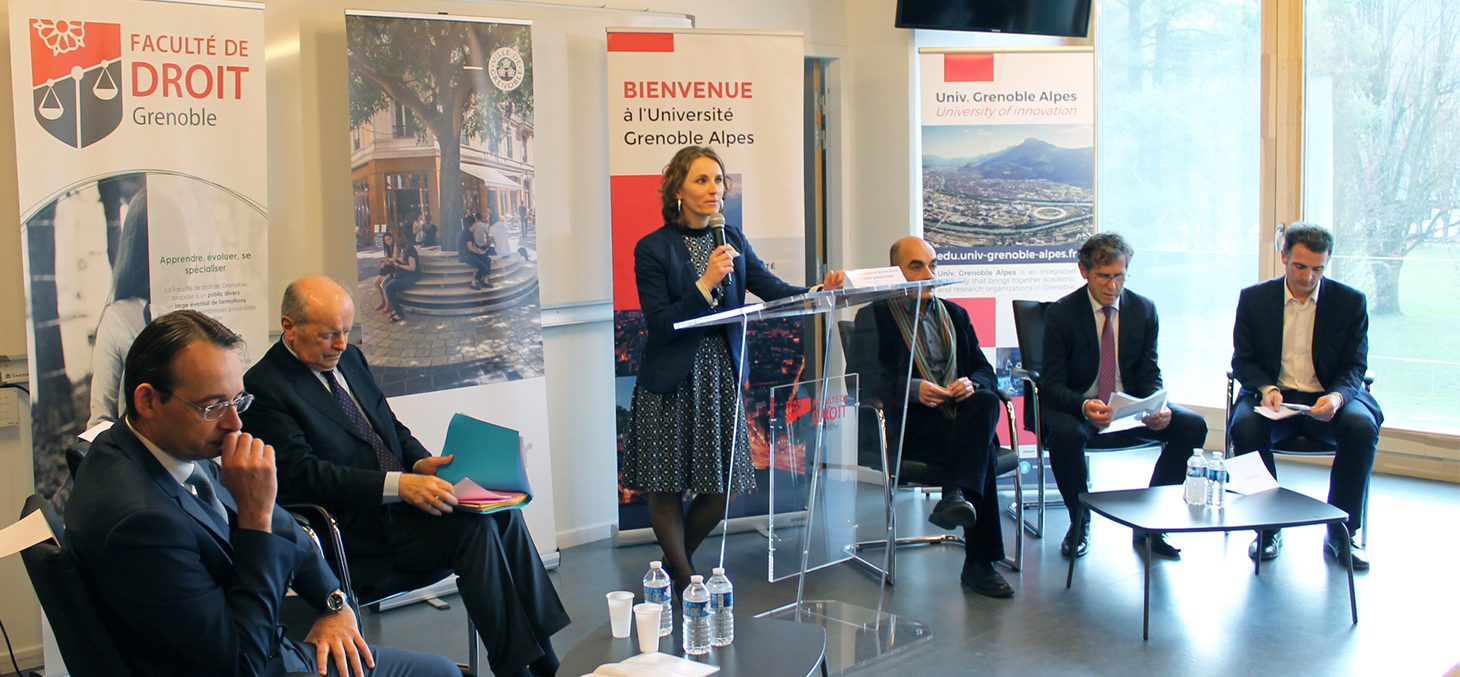
The Civil Liberties Legal Clinic was launched in January 2018 as part of the Master 2 in Fundamental Rights Litigation program at the Law School , under the leadership and coordination of Professor Anca Ailincai. This initiative, a winner of the 2017 IDEX Training call for proposals, enables students, under the guidance of academics and legal practitioners, to implement concrete actions promoting access to justice in response to social and educational challenges. To learn more about this topic, find below the answers to three key questions regarding the Civil Liberties Law Clinic.
Why did you launch this project?
The legal clinic is the result of two observations relating to the need to professionalize the training of our students and the difficulties of accessing the law. In response, the legal clinic project consists of setting up a social and educational system with two objectives. On the one hand, it aims to provide free legal services to the local population by contributing to access to justice for individuals in the Grenoble metropolitan area, with a view to democratizing legal knowledge. On the other hand, the project aims to promote the professional success of students by strengthening their training through innovative and professionalizing educational methods based on an active and autonomous approach on the part of the students. The aim is to enable students, supervised by academics and legal practitioners, to work on real-life cases with a view to developing appropriate legal diagnoses. The idea of a clinic thus responds to a current desire to transform teaching practices, placing the student at the heart of the learning process.
The Grenoble legal clinic project is not an isolated case. In fact, over the past decade, we have seen a growth in legal clinics in France. There are now around 20 such clinics, but only five specialize in human rights. A network of French-speaking legal clinics has been set up to promote the sharing of experience between different universities, with the projects undertaken within these clinics intended to evolve over time. The Grenoble clinic is part of this network.
Who is affected by this project?
About ten faculty members from the Law School participate in the clinic, which is open to anyone interested. Each project led by the clinic has its own team composed of academics and practitioners from Grenoble and elsewhere.
Students participating in the projects are thus involved in an educational project. This year, only students enrolled in the Master 2 program in Fundamental Rights Litigation are taking part in the experiment. All Master 2 students have signed up for one or more projects, depending on their interests and professional goals. Next year, the clinic should be open to Master 1 students who have chosen the "freedom rights" track (3 courses). Substantial participation in the clinic should entitle committed students to bonus points.
Finally, in order to implement the legal clinic, partnerships were established with several institutional partners: the Alliance of Lawyers for Human Rights (AADH), the Human Rights Institute of the Grenoble Bar Association, the City Hall, and the Communal Center for Social Action (CCAS) of Grenoble.
How is this project being implemented?
The clinic does not operate on a legal hotline basis. Projects are initiated in response to requests from partners. In exchange, professional partners participate in training students, with whom they work on real cases.
In 2018, three projects were launched as part of the legal clinic specializing in civil liberties, each with different operating procedures, partners, and timelines. The progress of these various projects will depend on the specific requests submitted by the partners and the students' capacity to carry out the work. Two projects are presented below:
This project, unique in France, launched on the initiative of Grenoble City Hall and the CCAS (Community Center for Social Action), was born and grew alongside the clinic, representing its most structuring and elaborate project to date.
The aim of the mobile legal team is to provide legal assistance to those who do not exercise their enforceable right to housing (DALO) and enforceable right to accommodation (DAHO), while strengthening existing support services for the public. This experiment should make it possible to improve the identification and support of people in need of accommodation or housing, but also to answer administrative and legal questions relating to the preparation of a DALO/DAHO appeal file that arise for professionals or volunteers, associations or institutions supporting the people concerned.
In addition to the Law School, the City of Grenoble, and the CCAS of Grenoble, this project involves numerous other partners: the Grenoble Bar Association, the Human Rights Institute of the Grenoble Bar Association, the Isère DALO/DAHO Monitoring Committee, the Federation of Solidarity Organizations, Un toit pour tous, the Abbé Pierre Foundation, and the Defender of Rights.
- A comic book project on transgender children's rights:
This project is being carried out in partnership with the Alliance of Lawyers for Human Rights. It was launched at the initiative of Attorney Mila Petkova, who handled the litigation regarding gender-neutral language and genital mutilation of intersex individuals. Drawing on personal accounts and legal research, the students enrolled in the project aim to create a comic book on the rights of transgender people. Supervised by a faculty member and a doctoral student, they have already met with various stakeholders, including: a transgender person (introduced through the Grenoble Bar Association), a psychiatrist from Grenoble University Hospital, and two psychologists from Alliance Adolescents (a counseling service for adolescents). The illustrations for the comic book will be created by a doctoral student from Lyon, who responded to a call for applications posted on the Law School’s Facebook page.
 Law School Law at the Top