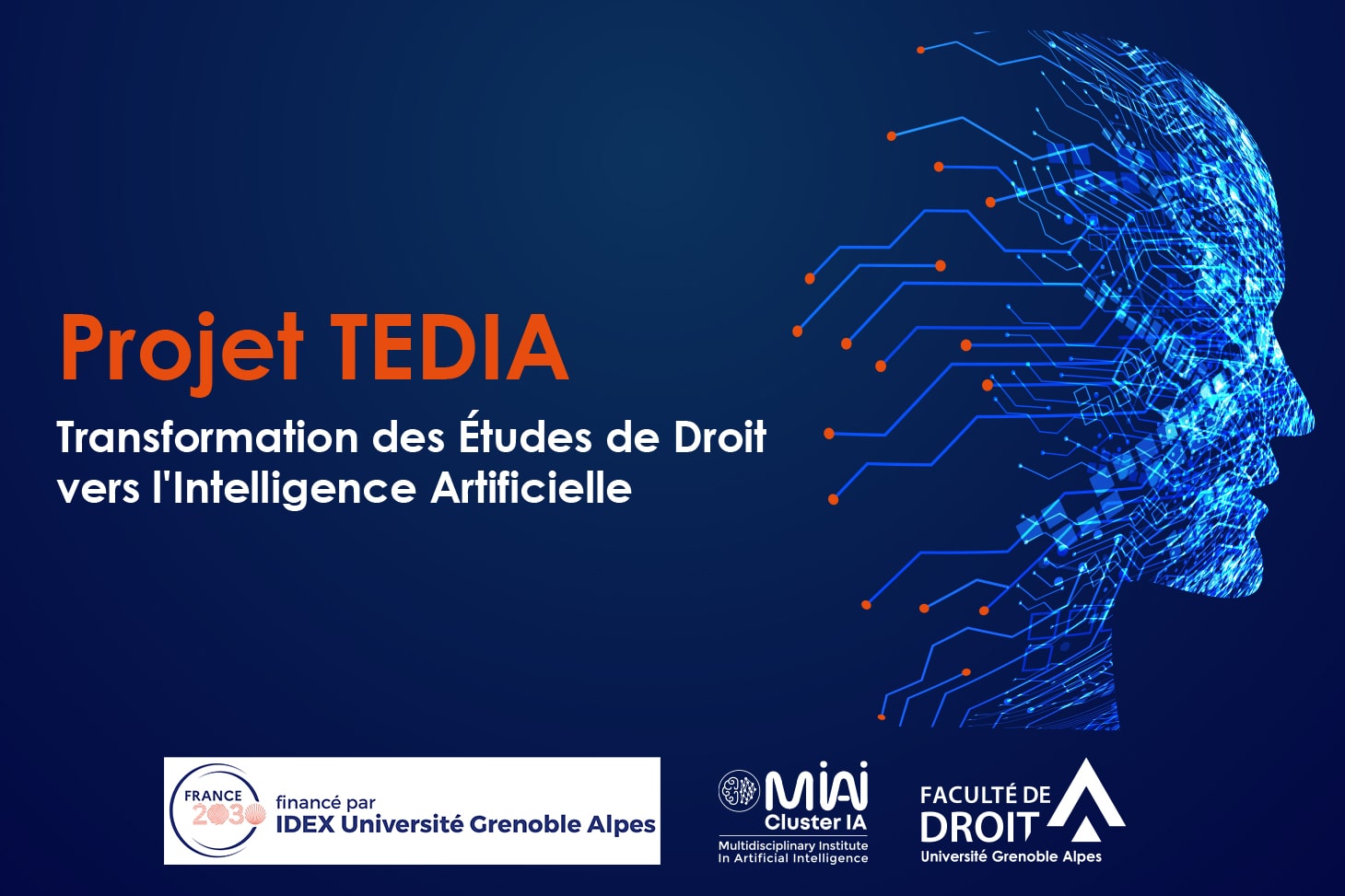
The "Transformation of Legal Studies toward Artificial Intelligence" (TEDIA) project, a winner of the "Emergents 2024" call for proposals from the IdEx Formation atUniversité Grenoble Alpes, aims to raise awareness and train law students, professionals, and faculty in the applications of artificial intelligence (AI). Throughout the 2025–2026 academic year, the project leaders, Mr. Romain Rambaud and Ms. Géraldine Vial, have implemented various initiatives that we invite you to explore.
Law School has introduced a course titled “Artificial Intelligence in Law” for second-year law students in the first semester of the 2025–2026 academic year (optional course).
This practical and theoretical course provides an introduction to operational legal AI for a broad audience, preparing participants for the transformation of various legal professions.
This course covers the legal aspects of AI, but focuses primarily on the theory and practice of operational AI, delivered through a hybrid format.
AI Week will be held from September 17 to 19, 2025
This inaugural week-long event on operational legal artificial intelligence, held on the Saint-Martin-d'Hères campus, was a resounding success, drawing nearly 300 participants (legal professionals, academics, and students) over three days and featuring some 60 speakers.
AI Week made a lasting impression with its unique format, combining:
lectures led by legal professionals, academics, and legaltech experts to learn about legal AI and the challenges it presents
a legal tech forum where about 15 developers of legal AI solutions were on hand to provide hands-on training
a 24/7 AI tool testing center where anyone can try out legal AI tools in real time to better understand how to use them and then apply them in a professional setting
Meeting with the legal documentation negotiators on May 4, 2025
Mr. Romain Rambaud, as a co-leader of the TEDIA project, was invited by the Couperin.org consortium—which brings together all French higher education institutions to negotiate and acquire electronic resources—to speak at their event dedicated to AI. During this event, he presented the TEDIA project and conveyed the following message: teachers and students must have access to AI tools in order to teach the law of today and tomorrow and to prepare students for their professional careers.
Organization of a conference on June 25 and 26, 2026
This end-of-project symposium, dedicated to "Legal Education in the Age of AI," is organized by the Grenoble Center for Legal Research, in partnership with the Conference of Deans' working group on AI.
IdEx Formation atUniversité Grenoble Alpes is a major player in the field of innovation and development. It enhances the quality of the courses offered byUniversité Grenoble Alpes supports innovative teaching and learning practices and interdisciplinary study programs.
MIAI Cluster (Interdisciplinary Institute for Artificial Intelligence) atUniversité Grenoble Alpes, which is a dynamic network of technology experts whose goal is to create an international institute of reference in Grenoble for embedded, interactive, and generative AI that serves humans and the environment, with an emphasis on frugality, reliability, and a desire to educate citizens and decision-makers about the challenges of artificial intelligence.
The Grenoble Legal Research Center (CRJ) is structured around three main areas of research (Justice and Freedom / Innovation / Public Action and Territories) but also develops cross-disciplinary scientific projects.
Contact
If you have any questions about the TEDIA project, please contact the project leaders:
Share linkCopyCopyClose modal windowShare this page URLI recommend this page:Available at this address :The page will then be accessible from your "My favorites" menu.Stop videoPlay videoMute soundPlay soundChat: Got a question?Chatbot Robo FabricaMatomo visitor statisticsX (formerly Twitter)
 Law School Law at the Top